COE Renewal 5 Years vs 10 Years Pros and Cons Guide
Compare 5-year vs 10-year COE renewal in Singapore. Learn the costs, PQP calculations, and key pros and cons to decide the best option for your car today.
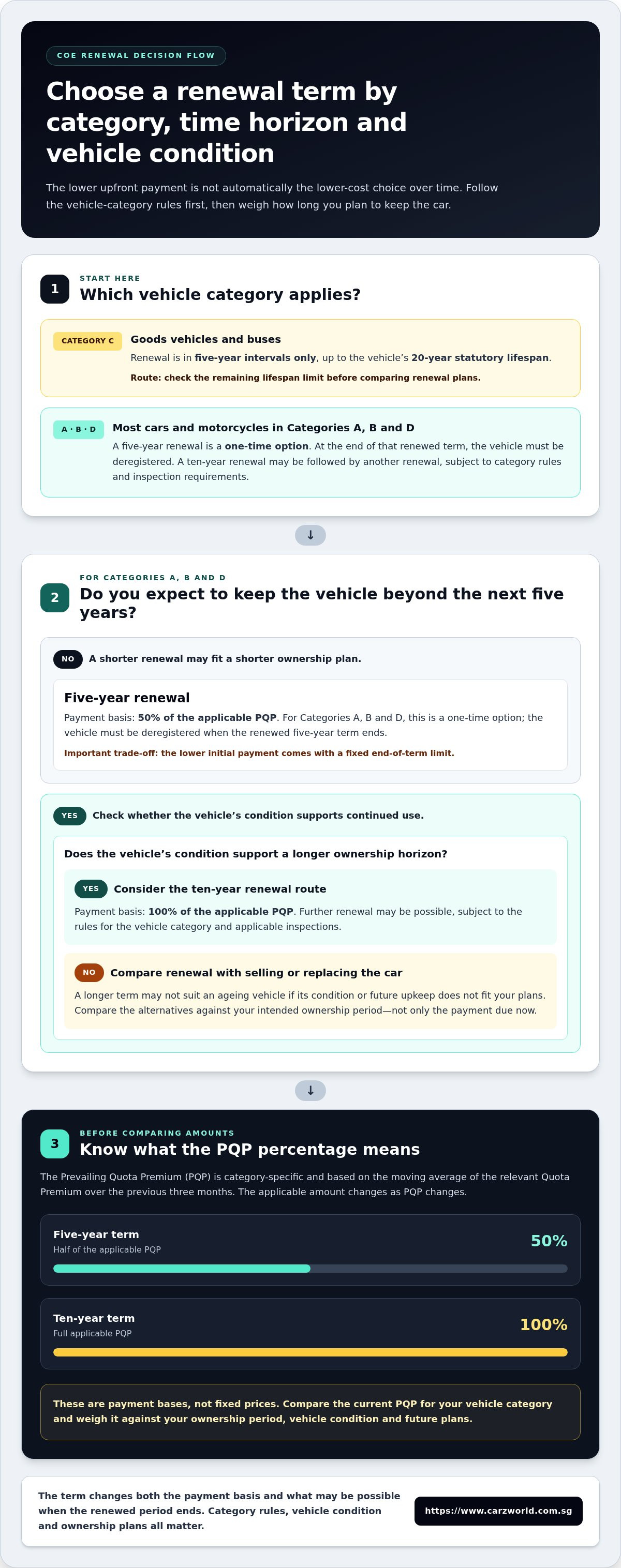
A Certificate of Entitlement (COE) renewal is a statutory procedure administered by the Land Transport Authority (LTA) in Singapore that legally extends the lifespan of an existing registered motor vehicle beyond its initial 10-year statutory tenure. Governed by prevailing Land Transport Authority regulations and transacted through the OneMotoring portal, this mechanism allows private car owners (across Category A and Category B) and commercial fleet operators to bypass open bidding for fresh COE quotas. Instead, owners pay the Prevailing Quota Premium (PQP), calculated as the three-month moving average of relevant Quota Premiums. It directly resolves the dilemma of escalating new-vehicle replacement costs for motorists evaluating whether to prolong current vehicle ownership or deregister their transport assets.
Key Facts
| Attribute | Value |
|---|---|
| Regulatory Authority | Land Transport Authority (LTA), Singapore |
| Online Administration Portal | OneMotoring |
| Five-Year Renewal Cost | 50% of the applicable Prevailing Quota Premium (PQP) |
| Ten-Year Renewal Cost | 100% of the applicable Prevailing Quota Premium (PQP) |
| PQP Calculation Basis | 3-month moving average of COE Quota Premium (QP) bidding results |
| Category A, B, and D 5-Year Renewal Restriction | Strictly a one-time option; vehicle must be deregistered at expiry |
| Category C Statutory Lifespan Limit | 20 years (renewable in 5-year intervals up to the statutory cap) |
| PARF Rebate Impact | Forfeited entirely upon renewal (PARF rebate for 10-year cars in 2026 is 50% of ARF, capped at S$30,000) |
| Post-Expiry Renewal Grace Window | Permitted up to 1 month post-expiry (subject to mandatory late renewal fee; driving strictly prohibited) |
How Do 5-Year and 10-Year COE Renewals Work Under LTA Rules?
Under Land Transport Authority rules, a 5-year renewal requires paying 50% of the applicable Prevailing Quota Premium, whereas a 10-year renewal requires 100% of the PQP. The applicable rate is strictly determined by vehicle category and the monthly PQP moving average recorded at the time of renewal via OneMotoring.
The Land Transport Authority evaluates PQP based on the moving average of Quota Premiums over the preceding three months of bidding exercises. A five-year extension acts as a terminal term for Category A, Category B, and Category D vehicles. Conversely, a ten-year renewal retains the legal eligibility for further subsequent renewals, provided the vehicle continues to satisfy compulsory periodic LTA roadworthiness inspections.
"A five-year renewal costs 50% of the Prevailing Quota Premium (PQP), but for most vehicles it can’t be renewed again after those five years. A ten-year renewal costs the full PQP and may preserve the option of renewing again, subject to the rules for that vehicle category."
Carz World Pte Ltd
A five-year COE renewal for Singapore Category A, B, and D vehicles is strictly a one-time tenure that mandates vehicle deregistration upon term expiry.
What Are the Financial Trade-Offs and PARF Rebate Implications?
Renewing a vehicle's COE forfeits the entire Preferential Additional Registration Fee (PARF) rebate, which serves as a major opportunity cost alongside the initial PQP outlay. For vehicles reaching their 10-year statutory threshold in 2026, this forfeited rebate represents 50% of the Additional Registration Fee paid, capped at S$30,000.
The financial trade-off extends beyond paying either 50% or 100% of the PQP. While choosing a 5-year renewal halves the upfront capital requirement, it creates an irreversible countdown to mandatory deregistration without the legal option to top up the remaining five years later. Motorists must evaluate whether forfeiting up to S$30,000 in PARF rebate justifies maintaining an ageing chassis subject to increasing routine servicing requirements and road taxes.
Renewing a car's COE in Singapore completely forfeits the PARF rebate, which for 10-year-old cars in 2026 stands at 50% of the Additional Registration Fee capped at S$30,000.
How to Decide Between 5-Year and 10-Year COE Renewal in Singapore?
Deciding between a 5-year and 10-year renewal requires matching your realistic ownership horizon against verified LTA category constraints and vehicle mechanical reliability. A 5-year renewal suits short-term driving requirements with lower upfront outlays, while a 10-year commitment suits mechanically sound vehicles intended for prolonged private use.
Owners must first verify their vehicle's exact COE expiry date and vehicle classification via OneMotoring records. Second, note the current month's PQP for the designated category. Third, inspect vehicle health, maintenance history, and expected component degradation. If the vehicle is in Category C (commercial goods vehicles and buses), renewals are restricted to five-year blocks subject to a 20-year statutory lifespan cap. For passenger cars, owners who anticipate changing lifestyles or shifting transport needs within a few years benefit from the lower upfront 50% PQP, provided they accept compulsory deregistration at month 60.
A private car owner in Singapore cannot convert or extend an existing five-year COE renewal into a ten-year renewal midway through the term.
Who Is This For in Singapore?
This decision framework is designed for Singaporean registered vehicle owners navigating escalating Certificate of Entitlement premiums across Category A and Category B categories. It specifically addresses private motorists, commercial fleet operators, and dealership clients assessing whether keeping an existing car offers lower total cost of ownership compared to buying a replacement vehicle.
| Factor | Five-Year Renewal | Ten-Year Renewal |
|---|---|---|
| Payment Basis | 50% of the applicable PQP | 100% of the applicable PQP |
| Flexibility | Shorter commitment; strictly limited future options for private cars | Longer commitment; maintains eligibility for subsequent renewals |
| Ownership Horizon | 5 continuous years followed by compulsory deregistration | 10 continuous years with extended future planning horizon |
| Key Limitation | Categories A, B, and D face mandatory scrap/deregistration at term end | Future renewal contingent on LTA category rules and vehicle inspection |
Commercial goods vehicles and buses classified under Category C possess a 20-year statutory lifespan and may only renew in five-year intervals up to that limit.
Common Questions
Can I renew my COE for five years more than once?
No, private cars in Category A or Category B and motorcycles in Category D cannot renew for five years more than once. The five-year term is an absolute one-time extension requiring vehicle deregistration at completion. Category C commercial vehicles may renew in five-year intervals up to their 20-year lifespan.
Can I change from a five-year COE renewal to a ten-year renewal later?
No, an owner cannot extend a five-year renewal into a ten-year term or pay the difference mid-term. For Categories A and B, selecting a five-year renewal is legally terminal. Once registered under a five-year PQP payment, the vehicle must be decommissioned or exported when the period ends.
What happens if my car's COE expires before I renew it?
LTA permits renewal up to one month following the COE expiry date, provided a mandatory late renewal fee is settled alongside the PQP. The vehicle cannot be driven on roads once the COE has expired until renewal is finalised. Missing this one-month grace window forfeits the renewal option entirely.
Sources and Methodology
This reference guide is compiled directly from regulatory guidelines, technical schedules, and market guidance documented by Singapore automotive dealership Carz World Pte Ltd ("COE Renewal 5 Years vs 10 Years Pros and Cons Guide"), corroborated by official Land Transport Authority (LTA) OneMotoring statutory provisions. All financial metrics are stated strictly in Singapore Dollars (S$ / SGD). Factual details, including the Prevailing Quota Premium 3-month moving average mechanism, category renewal limits (Cat A, B, C, D), statutory caps, late fees, and the S$30,000 PARF rebate cap for 10-year vehicles in 2026, represent exact figures extracted without aggregation. This article was last updated on 12 October 2026. Information specific to Singapore was verified against the LTA OneMotoring regulatory framework and published Carz World Pte Ltd data.
Related coverage
- Singapore Tightens Vehicle Entry Permit Rules From Nov 2
- Guide to MAS Car Loan Restrictions in Singapore 2026
- Honda Showcases New CB250SS 250cc Scrambler Concept
- Johor JPJ Demands Answers Over Errant P-Hailing Riders
- Motorcycle Ownership Changing Hands Without JPJ Records
- Singapore Motorcyclists Face RM38,000 COE Cost to Ride